
by: María José Gonzales
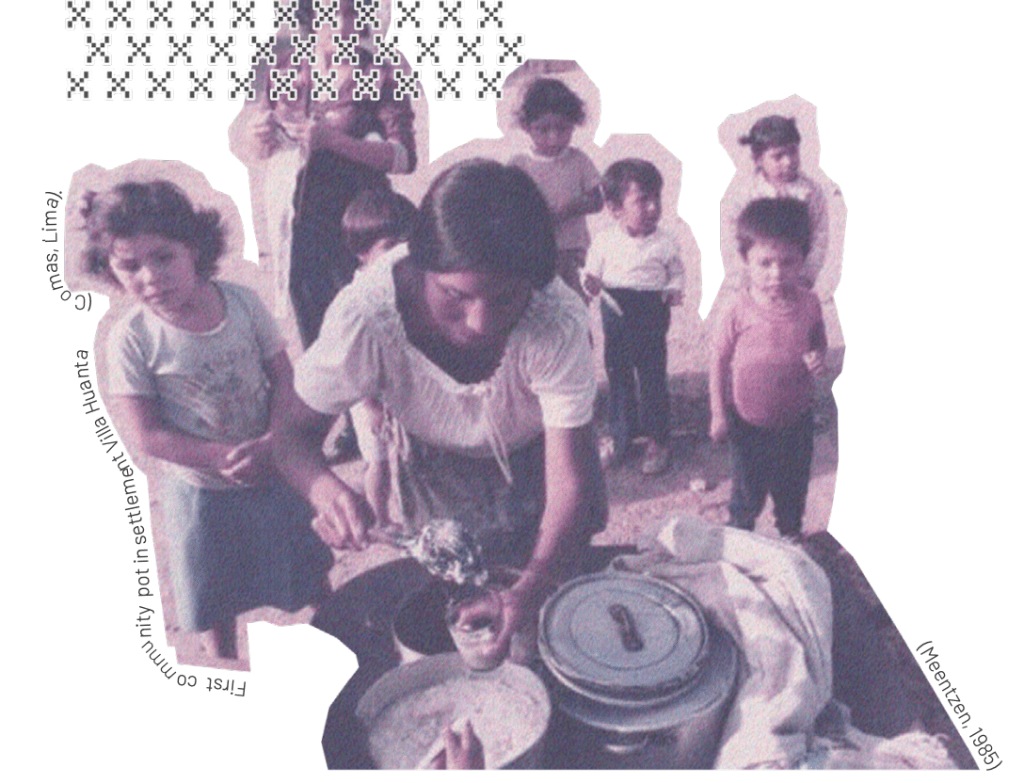
The act of nourishing works as a core element around which a constellation of scenarios has taken shape, weaving together diverse actors, struggles, and the creation of highly politicised spaces.
As an act of care, feeding has, in certain contexts, transcended its domestic boundaries, moving into the public and collective sphere.
However, following the embedded social construct of a feminine role and their work, collective care tasks have also predominantly become the responsibility of women, who weave networks of support and resistance to face the challenges presented by their specific contexts.
NOURISHING AS A CITY-MAKING PRACTICE
Comedores populares, merenderos, ollas comunes, soup kitchens, mense solidali, community kitchens, cantines solidaires, foodbanks o cozinhas coletivas are just a few of the names given to spaces that emerge through collective food practices across the globe. Beyond merely providing sustenance, these spaces have become platforms for community organisation, the exchange of knowledge, and the construction of solidarity networks and resistance towards diverse challenges.
In Peru, comedores populares emerged as a direct response to the mass migrations of the 1950s and 1960s. During this period, thousands of people left the Andean highlands in search of opportunities in Lima, a city unprepared to receive them (Matos Mar, 1984). In here, migrants faced not only the harsh living conditions in the city’s arid outskirts but also discrimination from those who considered them alien bodies to that territory. In this context, traditional Andean practices such as ayni (Quechua for ‘reciprocity’) and minka (Quechua for ‘collectivity’), became essential tools of resilience. These deeply rooted practices allowed communities to organise themselves for the collective benefit, deploying different activities that would give them the tools of an envisioned city and everything that comes with the right of being part of it.

While initially conceived as spaces of collective care, the comedores populares quickly transcended their primary role of providing food. Predominantly led by women, these spaces evolved into centres of community power, where social bonds were forged. These connections not only addressed fundamental needs but also fostered the creation of grassroots organisations and support networks, with women emerging as the backbone of this social production of the space (Barrig, 1991). These often expanded their roles to encompass other forms of communal care, becoming for instance, wawawasi (Quechua for ‘babyhouses’ – childcare centres), and even safe havens against domestic violence (Blondet & Trivelli, 2004). Moreover, they challenged traditional gender norms and disrupted societal expectations, leading many husbands to question why women needed their own spaces for discussion — ‘What could they possibly need to discuss?’
The impact of these spaces peaked during the 1980s, amid Peru’s internal armed conflict. In a country torn apart by violence from terrorist groups and state repression, comedores populares played a critical role as bastions of resistance and solidarity. Facing new waves of internal displacement due to violence, primarily from Andean regions, women took on the immense responsibility of feeding and protecting marginalised communities. What had initially arisen as a response to necessity evolved into a system of resilience (Blondet & Montero, 1995)—reference points of power within both community and urban discourse. These grassroots efforts extended their influence into political spheres (Sarmiento Viena, 2017), transforming these kitchens into what Miraftab (2004) describes as ‘invented spaces’: alternative and sometimes unofficial sites of action configured and shaped by grassroot movements.


Community kitchens became spaces of resistance against failing public services, patriarchal norms, and, later, an internal war. In such scenarios, women like María Elena Moyano and Emma Hilario emerged as emblematic leaders. These kitchens served as platforms to articulate social demands and defend those unjustly stigmatised as terrorists, all while confronting threats from both insurgent groups and the government. Their activism came at a great cost—forcing Emma to flee the country, while María Elena Moyano ultimately sacrificed her life (Minaya, 2015).
From Peru’s still-active comedores populares to Brazil’s cozinhas solidarias—crucial spaces often intertwined with the fight for housing—the communal pot becomes the nucleus of a constellation of simultaneous actions that transcend mere nourishment. What began in many countries as a simple act of sharing a meal or a glass of milk has evolved into what Fraser (1990) describes as ‘subaltern counter-public spaces’ led by women: sites that challenge power structures and articulate struggles for justice, resistance, dignity, and recognition.
BIBLIOGRAPHY
Barrig, M. (1991). Women and development in Peru: old models, new actors [Article]. Environment & Urbanization, https://doi.org/10.1177/095624789100300210
Blondet, C., & Montero, C. (1995). Hoy: menú popular: los comedores en Lima (IEP ediciones). UNICEF.
Blondet, C., & Trivelli, C. (2004). Cucharas en alto. Del asistencialismo al desarrollo local: fortaleciendo la participación de las mujeres.
Fraser, N. (1990). Rethinking the Public Sphere: A Contribution to the Critique of Actually Existing Democracy https://www.jstor.org/stable/466240
Matos Mar, J. (1984). Desborde Popular y crisis del Estado. El nuevo rostro del Peru en la década de 1980.
Meentzen, K. (1985) ‘Capacitación en organización y salud en el asentamiento humano
Huanta I – San Juan de Lurigancho’. (Collección Kathe Meentzen ). Available at: https://lum.cultura.pe/cdi/fotografia/capacitacion-en-organizacion-y-salud-en-el-asentamiento-humano-huanta-i-san-juan-de (Accessed: 8 July 2024).
Minaya R., J. (2015). No matarás ni con hambre ni con balas. Las mujeres de los comedores populares autogestionarios en El Agustino durante la violencia política. Anthropologica, 33(34), 165–186. https://dialnet.unirioja.es/servlet/articulo?codigo=5126137
Miraftab, F. (2004). Invited and Invented Spaces of Participation: Neoliberal Citizenship and Feminists’ Expanded Notion of Politics [Article]. Wagadu., 1. Sarmiento Viena, K. (2017). La disputa de las mujeres por el hábitat popular: la experiencia de los comedores populares autogestionarios de El Agustino, Lima. Bulletin de l’Institut Français https://doi.
org/10.4000/bifea.8864

 TheCityOtherwise
Deja un comentario