
by: Diana Armacanqui
THINKING FROM THE FUTURE
Drawing from the insights of my master’s studies over the past year and my lived experiences, this reflective exercise imagines the future of a cherished space in present-day London: Towpath Gardens along Regent’s Canal in Islington. Written from the perspective of an Islington resident in the year 2050, it reflects on the evolution of this space over 25 years.
As a current resident of Islington, I often visit Towpath Gardens with a local community gardening group. Together, we grow tomatoes, greens, berries, and garlic; tend compost piles; and plant and prune pollinator flowers. These activities are always accompanied by lively conversations about the future of this space—its potential to nourish more people and serve as a welcoming community hub. What follows is a vision of this space reimagined, looking ahead to its radical possibilities.
MUTUAL AID / AYNI / MUTIRÃO

Throughout history and across cultures, practices like mutual aid, ayni, and mutirão have embodied relational care rooted in reciprocity, mutual support, and solidarity. These practices reject the notion of transactional exchanges, focusing instead on collective well-being.
In English-speaking contexts, mutual aid refers to grassroots efforts where people share resources, skills, and support to meet communal needs. In Andean cultures, ayni is a tradition of reciprocity that extends beyond human relationships to include Pachamama, or Mother Earth. Originating in Incan traditions, acts of labor, care, or exchange are understood as part of a cycle, eventually returning to benefit the wider community and the environment. In Brazil, the term mutirão comes from the Tupi-Guarani language and describes a group of people working together to create something for the collective good.
In 2024, Islington was one of London’s most unequal boroughs, a place where extreme wealth coexisted with stark deprivation. For many residents, Islington felt like a borough filled with high-end shops and restaurants, yet spaces for genuine neighborly connection were rare.
Inspired by these care traditions, some residents saw potential in the Towpath Gardens. A free bike repair pop-up was established to serve the many cyclists passing along the canal. Soon after, a community fridge was introduced, stocked with surplus herbs and vegetables from the garden. Over time, neighbors began contributing surplus items of their own. By 2050, the community fridge has become a cornerstone of the canal—a powerful symbol of neighbors caring for neighbors. The bike repair initiative has since expanded to include mending clothes and jewelry, fostering a culture of sharing and skill-building.
PLURIVERSAL IMAGINATIONS AND SITUATED KNOWLEDGES
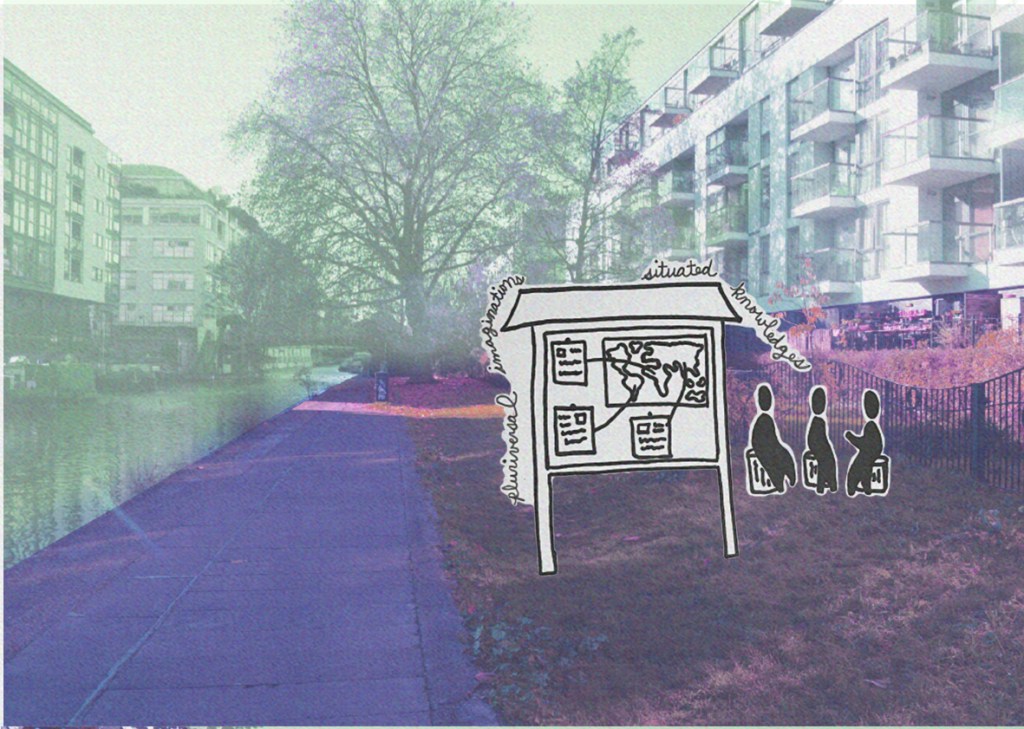
Anthropologist Arturo Escobar advocates for a recognition of the “pluriverse”—a world made of many worlds. His concept emphasizes the coexistence of diverse ways of knowing, being, and living, challenging the dominance of a singular, universal worldview. Similarly, scholar Donna Haraway’s notion of “situated knowledges” highlights that all knowledge is partial, embodied, and rooted in specific contexts rather than being universal. These perspectives invite us to explore ecological stewardship and spatial justice through multiple lenses and boundless possibilities.
Islington has long been home to a rich tapestry of nationalities, religions, and ethnicities. Yet, in 2024, public spaces rarely reflected this diversity. Residents yearned for visible expressions of their identities in their own neighborhoods.
In response, local artists saw an opportunity to transform the fence of Towpath Gardens into a vibrant mural celebrating the area’s diversity. As more people noticed the mural, conversations about community connections emerged. Neighbors began using the space for storytelling circles, sharing experiences, and exchanging wisdom. In the year 2050, the Living History Wall has become a celebrated feature along the canal, inviting passersby to learn about the neighborhood and its residents. These gatherings have deepened local relationships, revealing shared experiences that many never knew they had.
RIGHT TO THE CITY
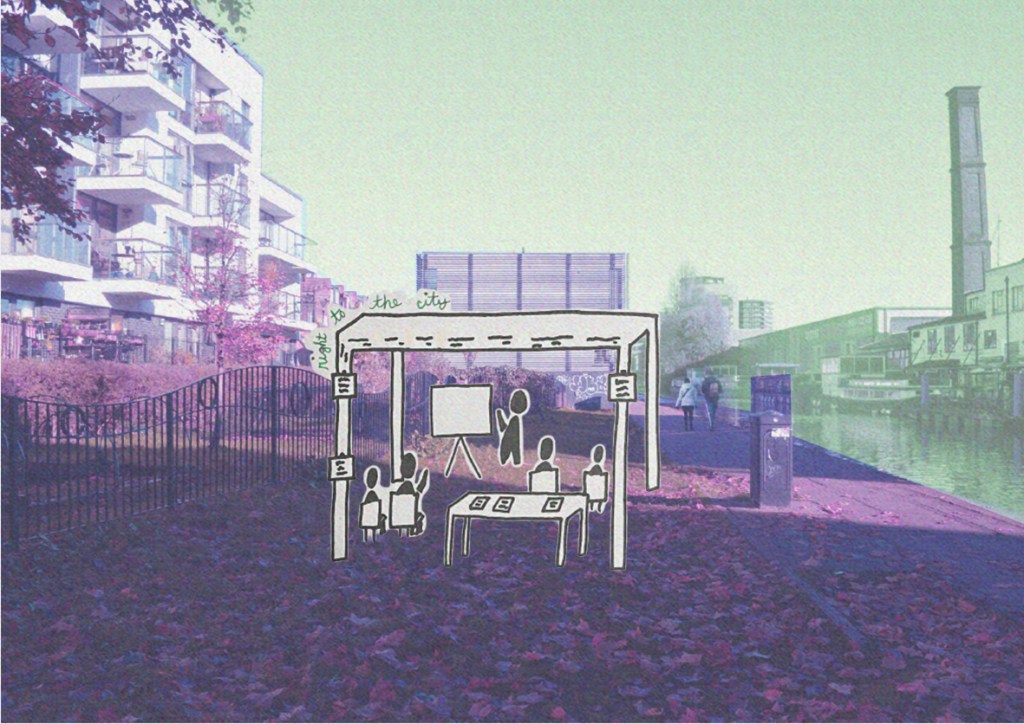
Philosopher Henri Lefebvre’s concept of the “Right to the City” asserts the collective power of urban residents to shape, access, and participate in the transformation of urban spaces. It champions the idea of reclaiming spaces for community use and lived experiences rather than for commodification.
Towpath Gardens, with its accessible location and tranquil greenery, began attracting community groups for organizing efforts. On any given day, hundreds of people pass by the canal, and many became curious about the activities taking place. Neighbors who wanted to get involved with local causes but didn’t know where to start found inspiration here.
As interest grew, part of the space was transformed into a covered meeting area, enabling groups to gather and organize effectively. By 2050, Towpath Gardens has become a hub for local activism, hosting housing advocates, climate action groups, and other initiatives. The space now fosters collaboration, empowering residents to learn from one another and work collectively toward a more just future.

 TheCityOtherwise
Deja un comentario